Oak species guide
The oak we build with
English oak, green oak, seasoned oak, what the words mean, which species we use, and why oak has framed Britain's finest buildings for a thousand years.
In short
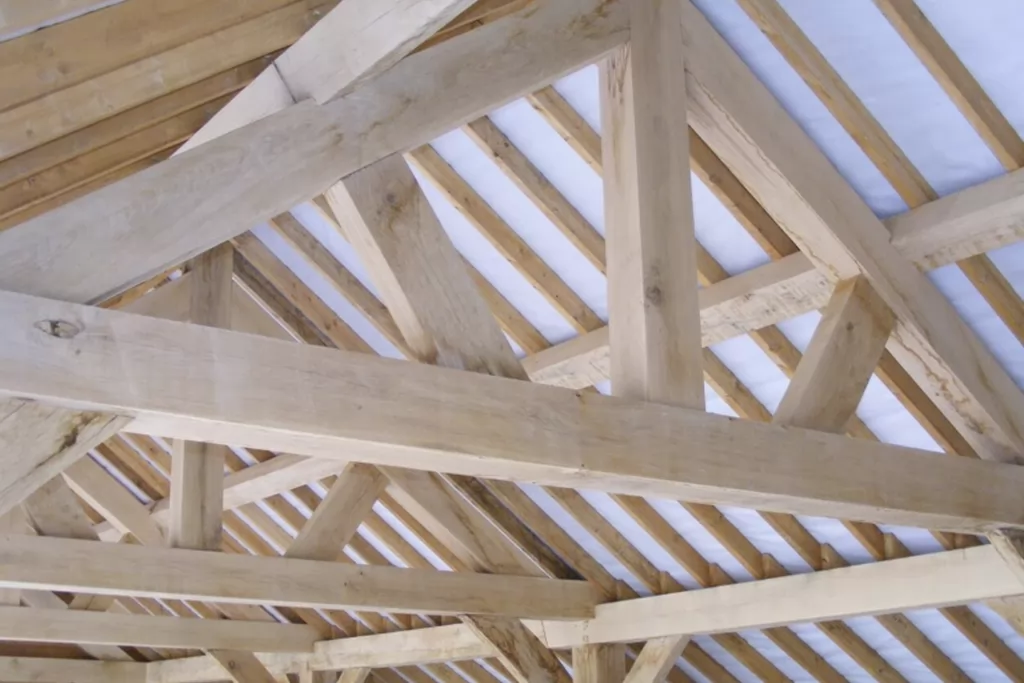
We build most frames from French green oak, European oak (Quercus robur) supplied through established French sawmills and produced using traditional pegged framing joints. It is dense, naturally durable and develops the characterful movement and silver-grey weathering associated with oak buildings.
'Green oak' refers to freshly sawn timber above 30% moisture, not a species. We shape it while it retains more of its natural moisture because it is workable during manufacture and then gradually seasons in place. Where stability matters most, internal beams and fine joinery, we use air-dried (seasoned) oak instead.
The species
Which oak is which?
Three oaks you'll meet in timber framing, and where we use each one.
French green oak (European oak)
Quercus robur
France (our main source)
The classic framing oak. We source mainly through established French sawmills, where the slow-grown European oak is dense, straight and full of character, with deep grain and prominent medullary rays. It cuts cleanly green and seasons to a rich amber that weathers to silver-grey. This is the oak we use for almost every frame.
Used for
All structural oak frames, garages, garden rooms, gazebos, porches
Sessile oak
Quercus petraea
France, UK & Ireland
Closely related to European oak and often growing alongside it. Slightly finer-grained and straighter, it performs almost identically in framing. We use it where the timber's qualities suit the joint, occasionally drawn from the same French forests.
Used for
Structural frames and fine internal beams
American white oak
Quercus alba
North America
A different white oak group, paler and with a more even grain. It's not our default for green-oak framing, British and European Quercus robur has the superior character and provenance for heritage buildings, but we can use it for specific joinery on request.
Used for
Selected internal joinery and furniture, where specified
Green oak vs seasoned oak
Two routes from the same tree
Green oak and air-dried oak come from the same species, the difference is moisture. Here's how to choose.
Green oak
- • Freshly sawn, moisture content above 30%
- • Workable while green and well suited to traditional framing joints
- • More affordable and widely available in large sections
- • Develops splits and silver-grey colour as it seasons in place
- • Natural movement and surface checking develop as the timber seasons
When we use it: Our default for garages, gazebos, porches and garden rooms
Air-dried (seasoned) oak
- • Dried over 1-3 years, moisture content 18-25%
- • More stable, far less movement after installation
- • Takes crisper, finer detail for internal joinery
- • Higher cost and longer lead time
- • Best where minimal movement and a settled look matter most
When we use it: Internal beams, fine joinery, extensions and restorations
Why oak
The properties that make oak the framing timber
Dense, durable, strong and a pleasure to work, here's what oak brings to a frame that other timbers don't.
Natural durability
Oak is naturally durable, and good detailing helps manage exposure and moisture. Long-term performance depends on correct installation, weather protection, inspection and maintenance.
Workability
Green oak is workable during production, which is one reason it has long been used for traditional timber framing. Mortises, tenons, braces and pegged connections can be formed before the timber seasons in place.
Strength
A dense hardwood (around 720 kg/m³ seasoned), oak gives exceptional strength-to-section ratios, allowing generous spans on visible frames.
Movement
Green oak gradually loses moisture after installation. Natural movement and surface checking are expected characteristics that are considered in the frame design.
Sourcing & sustainability
Established sourcing, project-specific records
We work directly with established sawmills and share the sourcing information available for each project.
Project sourcing information
We work directly with established sawmills and can provide the sourcing information available for the timber supplied to your project.
French green oak
Most of our oak is supplied through established French sawmills, selected for the quality, grain and consistency required for structural framing.
Low carbon, reusable
Solid timber frames use demountable joinery and may be suitable for dismantling and reuse, subject to their condition and the requirements of the new setting.
People also ask
Your oak species questions
Concise, snippet-ready answers to the questions buyers ask most about the oak in their building.
What oak do you use for framing?
We mainly use French-grown European oak (Quercus robur) for green-oak framing, supplied through established French sawmills. It offers the density, strength and workability required for traditional structural framing.
What does 'green oak' mean?
Green oak is freshly sawn timber with a relatively high moisture content. It is workable during production and then gradually seasons after installation, developing the natural movement, surface checking and colour changes associated with traditional oak framing.
Is oak a hardwood or softwood?
Oak is a hardwood, dense, strong and naturally durable. It's one of the strongest timbers used in British construction, which is why it's been the framing choice for centuries.
Will my oak frame rot?
No. Oak's high tannin content makes it naturally resistant to rot and insects. The only real threat is trapped moisture, which we design out with a sound roof and ventilated detailing.
Does oak need treating?
Generally no. Exterior oak is left to weather to silver-grey and resists rot unaided. Interior oak may be waxed or oiled to enhance the grain, but it's not required for durability.
Dig deeper
Frequently asked questions
A little more detail on the oak we build with.
We build almost every frame from French green oak, European oak (Quercus robur) supplied through established French sawmills, with Sessile oak (Quercus petraea) used where its qualities suit the joint. Both are hardwoods traditionally used in timber framing.
Not quite. 'Green oak' describes the moisture state, freshly sawn timber above 30% moisture, not the species. Our frames are produced mainly from French-grown European oak (Quercus robur), supplied through established French sawmills and selected for framing quality and consistency.
Green oak is traditionally used for structural oak framing because it is workable during manufacture and gradually seasons after installation. Natural movement, surface checking and colour changes may occur as it dries. Air-dried oak is more stable, so we use it where minimal movement matters, including internal beams and fine joinery.
Our structural oak is supplied through established French sawmills. We can provide the sourcing information available for your project.
A well-designed oak frame can serve generations when correctly installed, kept weather-tight and maintained. Service life depends on detailing, exposure, moisture management and ongoing maintenance.
The craft behind the timber
Why Southern Oak builds the way we do
The specialists who cut your frame, and what sets our approach apart.
What makes Southern Oak different?
Frames are produced through our specialist sawmill partner using traditional mortise-and-tenon joinery, while Southern Oak coordinates the design, planning and installation around your home and plot. The result combines traditional oak-framing principles with modern structural design and project management.
Why choose Southern Oak?
Southern Oak coordinates the process from initial design and planning through specialist frame production and on-site installation. Planning support is provided with Planning By Design where required.
How are Southern Oak's buildings constructed?
Frames are produced from selected green oak using traditional mortise-and-tenon joints through Southern Oak's specialist sawmill partner in France. Experienced specialist installation teams then carry out the on-site work.
Keep reading
Related guides & buildings
Want oak you can trust?
Talk to us about sourcing, species and specification for your oak framed building.
Request your quote