Oak joinery guide
The joints that hold a frame for centuries
Mortise and tenon, drawboring, oak pegs, the traditional joinery used in oak framing, and how a green oak building is produced and raised.
In short
Traditional mortise-and-tenon joints and oak pegs form the principal visible connections in Southern Oak frames, with the final jointing and fixing specification determined by the approved design and engineering requirements.
The pegs draw each joint tight and lock it under tension at assembly. As the green oak seasons, natural movement and surface checking can occur, and the frame is designed to accommodate those expected changes.
The joints
Six joints in every oak frame
Each has a job, to take a load, resist a force, or extend a run. Together they make a frame that outlasts us all.
Mortise and tenon
The cornerstone of timber framing. A projecting tenon on one timber fits into a matching mortise (slot) cut into the next. Pegged through, it resists tension and shear and has held frames together for a thousand years.
Drawbore and peg
The peg holes in the tenon are offset fractionally from those in the mortise. Driving an oak peg through pulls the joint tight at assembly, locking it under tension without glue or metal. The frame is detailed to accommodate the natural movement that occurs as green oak seasons.
Lap joint
Two timbers cross or meet at the same level; material is removed from each so they sit flush and bear onto one another. Used where a post meets a plate or in intermediary framing.
Scarf joint
Where a single span needs more than one timber, a scarf joins two beams in line with interlocking faces and pegs, extending the run without losing strength. The mark of a framer working with what the forest provides.
Brace (knee) joint
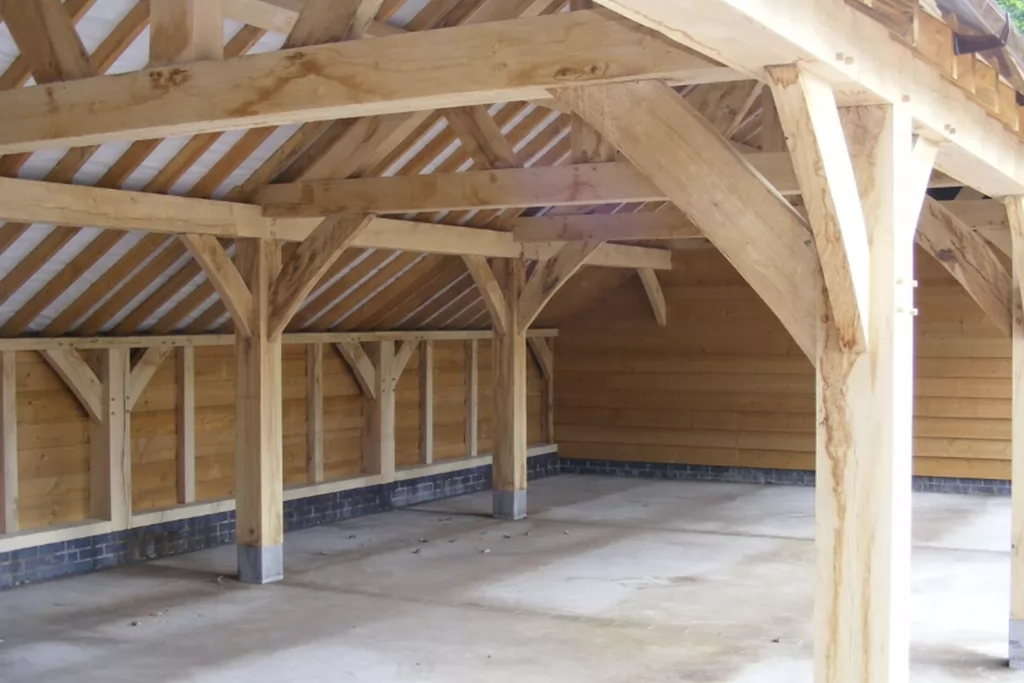
Diagonal braces tie post to plate or post to tie beam, stiffening the frame against racking. The brace is tenoned at both ends and pegged, the skeleton of a frame's lateral strength.
Dovetail
A fan-shaped tenon that resists pull-out by its own geometry. Used in tension members, floors and certain joinery where a mechanical, self-locking hold is wanted.
How a frame is cut
From template to raised frame
A clear overview of how a bespoke green oak frame moves from approved design through production to raising on site.
Design & set-out
Design & set-out
Every frame starts with approved drawings that establish the dimensions, spans, roof pitch and joint positions before production begins.
Joint marking
Joint marking
Joint positions are transferred from the approved design onto the individual timbers using the production method appropriate to the frame and specialist sawmill.
Cutting mortises & tenons
Cutting mortises & tenons
Mortises, tenons, braces and other joints are produced by the specialist framing team using the tooling and methods suited to the oak and the approved design.
Drawboring the peg holes
Drawboring the peg holes
Where drawbored joints are specified, the peg holes are deliberately offset so that driving the peg pulls the joint tight during assembly.
Production checks
Production checks
Components are checked, identified and prepared for assembly before delivery. The exact quality-control and pre-assembly process depends on the frame and production specification.
Raising on site
Raising on site
The frame is raised onto the prepared base, with posts, beams and braces assembled and pegged in sequence. Frame-raising time depends on size, access and complexity and is confirmed for the individual project.
The framer's kit
Tools and pegs
Traditional framing uses a distinctive set of marking, cutting, boring and finishing tools alongside modern production equipment where appropriate.
Traditional framing tools
- • Framing chisels & a wooden mallet
- • Handsaws, rip and crosscut
- • Augers and a brace, for boring peg holes
- • Framing square and a marking gauge
- • Plumb bob and chalk line
- • Drawknife and spokeshave, for finishing
The oak peg
Traditional oak framing uses hardwood pegs shaped to suit the joint. In a drawbored connection, driving the peg through the offset holes pulls the tenon into the mortise and tightens the assembly.
Pegged joinery avoids visible steel brackets at the principal traditional joints and allows the connection to work with the natural characteristics of the timber as the frame seasons.
People also ask
Your oak joinery questions
Concise, snippet-ready answers to the questions buyers ask most about how an oak frame is built.
What is a mortise and tenon joint?
It's the joint at the heart of oak framing: a tenon (projection) on one timber fits into a mortise (slot) cut in another, then pegged through. It resists tension and shear and has held frames together for centuries.
How are oak frames held together?
Traditional oak frames use mortise-and-tenon joints and oak pegs, with drawboring used where specified to pull the joint tight. Concealed project-specific fixings may also be used where engineering or roof details require them.
What does drawboring mean?
Drawboring offsets the peg hole in the tenon slightly from those in the mortise, so driving a peg through pulls the joint tight. It locks the joint mechanically without any fasteners.
Why are pegged joints used in oak framing?
Pegged joints provide the traditional fastening method and clean appearance associated with oak framing. The frame is designed to accommodate the natural movement that occurs as green oak seasons.
How long does it take to produce an oak frame?
Production time depends on the frame size, complexity, engineering, material availability and the sawmill programme. Your quotation and project programme will confirm the expected manufacture and installation sequence.
Dig deeper
Frequently asked questions
A little more detail on the joinery and the build.
Mortise and tenon joints, pegged connections and diagonal brace joints are central to traditional oak framing. Scarf, lap and other joints may also be used where the structural design requires them.
Pegs draw a joint tight through drawboring and lock it under tension at assembly. The frame is then detailed to accommodate natural movement as the green oak seasons. Pegs provide the traditional fastening method and visual character of the joint.
Drawboring offsets the peg hole in the tenon slightly from those in the mortise, so driving an oak peg through pulls the joint tight. It's an ancient technique that locks a joint without glue or metal.
No structural metal. Joints are pegged oak, the way they have been for centuries. We may use stainless fixings only where a building's roof structure or building regs demand it, and even then they're concealed.
Frame production is carried out through our specialist sawmill partner in France. Production visits are not a standard part of the service, but we can confirm what production information or imagery is available for your project.
The hands behind the frame
Built by people who care about the joint
The framers who cut your oak, and what sets our craft apart.
What makes Southern Oak different?
Frames are produced through our specialist sawmill partner using traditional mortise-and-tenon joinery, while Southern Oak coordinates the design, planning and installation around your home and plot. The result combines traditional oak-framing principles with modern structural design and project management.
How are Southern Oak's buildings constructed?
Frames are produced from selected green oak using traditional mortise-and-tenon joints through Southern Oak's specialist sawmill partner in France. Experienced specialist installation teams then carry out the on-site work.
Why choose Southern Oak?
Southern Oak coordinates the process from initial design and planning through specialist frame production and on-site installation. Planning support is provided with Planning By Design where required.
Keep reading
Related guides & buildings
Want to understand how your frame will be produced?
Ask us about the jointing, timber specification and production information available for your individual project.
Discuss your frame