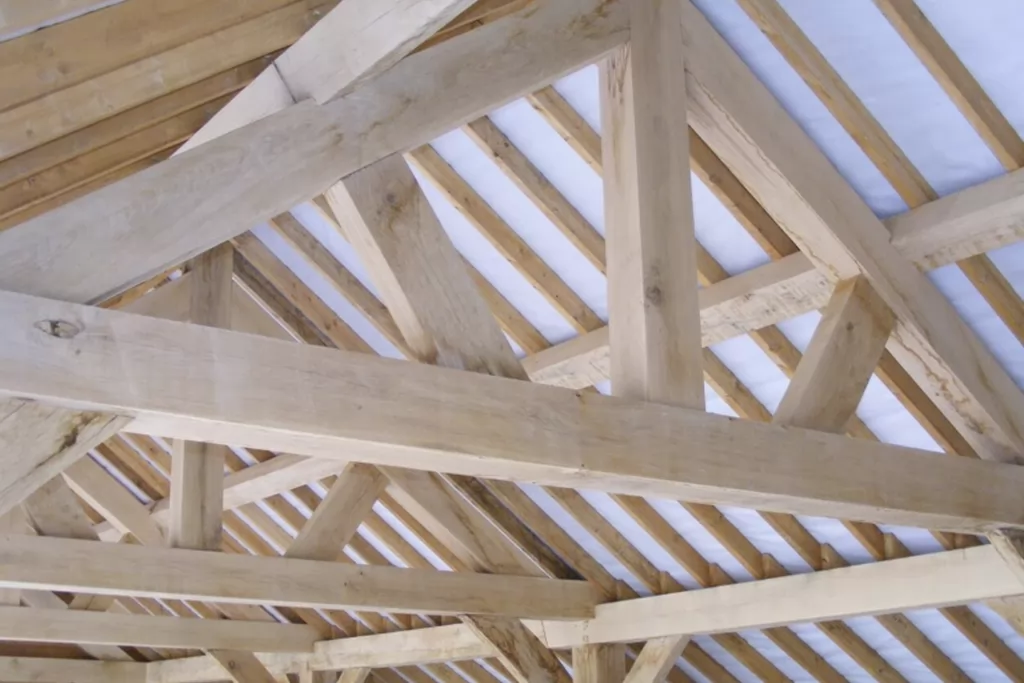
Materials
Understanding oak movement, shakes and checking
Drying checks and movement are common in green oak. Learn what to expect, what to monitor and when to request a professional assessment.
If you've noticed cracks appearing in a recently installed oak frame, they may be normal drying checks, but their significance depends on their position, depth and relationship to the joints. This guide explains what commonly happens as green oak seasons and when it is sensible to ask for a professional assessment.
What is checking?
Checking is the term for the surface cracks that appear in oak as it dries. As green oak loses moisture, the wood shrinks — but it shrinks unevenly. The surface, which dries fastest, shrinks more than the core, and the resulting tension causes the wood to crack open.
Checks commonly run along the grain rather than across it. Many surface checks are expected in green oak framing, but appearance alone cannot confirm that a structural member or joint is unaffected.
Why does oak move?
Oak is a hygroscopic material — it absorbs and releases moisture in response to the surrounding humidity. This means it:
- Swells in humid conditions (absorbing moisture)
- Shrinks in dry conditions (releasing moisture)
For green oak, the first few years involve significant moisture loss as the timber seasons from its initial 50%+ moisture content down to equilibrium with the environment (around 12–18% for exterior use).
The timeline of movement
The first 1–3 years
This is when the most dramatic movement occurs. Your frame will:
- Develop surface checks (cracks) — most visible on large section beams and posts
- Shrink slightly in cross-section (typically 3–5% across the grain)
- Twist very slightly as different faces dry at different rates
- Settle as the timber seasons and traditionally detailed joints tighten in the way anticipated by the frame design
Years 3–10
Movement slows significantly. The frame reaches equilibrium with its environment. Seasonal movement continues — tiny expansion in winter humidity, tiny contraction in summer dryness — but this is barely perceptible.
Beyond 10 years
The frame is fully seasoned. It will continue to move marginally with the seasons for the rest of its life — this is what makes oak a living material, and part of its enduring appeal.
Is it a problem?
Usually not, but it depends on the detail. Oak framing has been developed over centuries to accommodate predictable timber movement. Traditional joints — including mortise and tenon, drawbore pegging and lap joints — are detailed to work with that movement. As the oak seasons:
- Pegs tighten in their holes, locking joints more firmly
- Tenons wedge tighter into their mortises
- Joint fit may tighten as the timber seasons, where this has been allowed for in the design
This is why a green oak frame is engineered with specific tolerances — we cut joints to account for the shrinkage that will occur.
When to be concerned
While checking and movement are normal, there are a few things worth monitoring:
Excessive checking in structural members
Large, deep or rapidly changing checks in primary structural members should be assessed, particularly where they cross a joint, reduce the effective section or are accompanied by distortion. If you are unsure, send photographs and dimensions so the detail can be reviewed and, where necessary, referred to a structural engineer.
Checks through a joint
If a check runs directly through a joint (mortise or tenon) and appears to be separating the joint, this may need attention. This is rare but can happen.
Fungal growth or softness
If checks or surfaces develop fungal growth or feel soft and spongy, this may indicate a moisture problem — water is sitting in the crack rather than draining. This is more common in exposed horizontal surfaces.
Designing for movement
We design every frame to accommodate movement:
- Roof coverings are fixed to allow for timber shrinkage without cracking tiles
- Glazing uses flexible sealants that move with the frame
- Doors and windows in air-dried oak are more stable, with movement-tolerant fixings
- Base details allow water to drain away rather than pool
This article is general guidance and is not a structural assessment of an individual frame. If movement is significant, changing or connected to a joint, seek project-specific advice.
Have a question about your oak frame? Contact our team — we're always happy to help.
From the guide to the build